The Friction Problem: Engineering Predictable ROI in Generative Video Ads

For years, video production has been the most expensive and slowest gear in this machine
ELDIGITALDECANARIAS.NET/London
Performance marketing thrives on the ability to fail fast and pivot faster. In the era of algorithmic feeds, the bottleneck isn't the bid strategy or the audience targeting—it is the creative volume. Teams today are required to test dozens of hooks and visual iterations weekly just to maintain a baseline Return on Ad Spend (ROAS).
For years, video production has been the most expensive and slowest gear in this machine. Generative AI promised to fix this, but for many teams, it has introduced a new kind of friction: the "slot machine" effect. You pull the lever on a prompt, get a beautiful clip, and then find it impossible to replicate that specific lighting or character in a second shot. This lack of predictability is where ROI goes to die. To move from novelty to a functioning creative pipeline, teams must stop treating the AI Video Generator as a magic wand and start treating it as a production engine.
The High Cost of Inconsistent Creative Outputs
The primary struggle for performance teams isn't generating a "cool" video; it is generating a usable one. In a traditional motion graphics or live-action workflow, the director has absolute control. If the client wants the product to be 20% larger or the background to be blue instead of teal, the editor makes the change.
In the early stages of generative media, that control was non-existent. You might generate a high-converting hook, but when you try to generate a variation for a different demographic, the AI gives you a completely different visual style. This inconsistency is a liability. If you cannot maintain brand DNA across 50 variations of an ad, the AI isn't saving you time—it’s creating a management nightmare for the creative lead.
Furthermore, "one-off" success is a trap. A single viral AI-generated clip that cannot be iterated upon provides no data for future campaigns. Performance marketing relies on isolating variables. If you change the background, the lighting, and the actor’s expression all at once because the generator felt like it, you haven't run a test; you’ve just gambled.
Architecting a Modular Video Pipeline
To solve the friction problem, sophisticated teams are moving toward a modular approach to video. Instead of trying to generate a 30-second ad in one prompt, they break the asset down into its constituent parts: the Hook (0-3 seconds), the Body (15-20 seconds), and the Call to Action (CTA).
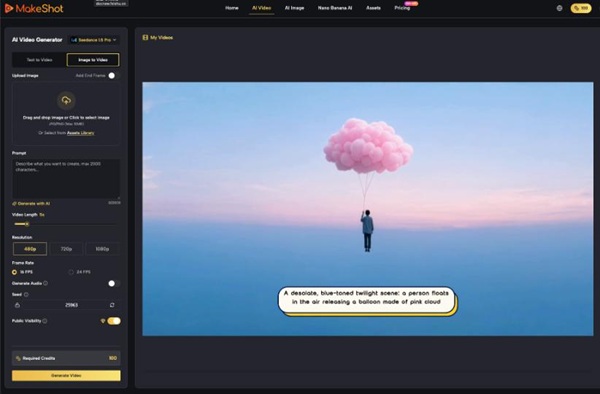
By using a unified platform like MakeShot, teams can access multiple underlying models—such as Kling, Veo, or Runway—through a single interface. This reduces the friction of learning the specific prompt engineering quirks of five different tools. The objective is to build a central repository of "visual DNA."
Unifying the Tech Stack
The fragmentation of the AI landscape is a hidden cost. One model might be excellent at photorealistic human movement, while another excels at surreal motion graphics. Switching between tabs, managing five different subscriptions, and manually matching color grades across tools is an operational drain.
A professional-grade AI Video Generator workflow acts as a layer of abstraction. It allows the creative operator to focus on the output rather than the infrastructure. When you can toggle between different generation engines within the same project space, you can maintain a "master style" more effectively. This allows the team to deploy the right model for the right segment of the ad without losing the visual thread that keeps the campaign cohesive.
The Iteration Loop: From Prompt to Performance Data
The role of the creative director is shifting from "maker" to "curator." When you can generate 100 variations of a background in the time it used to take to render one, the bottleneck shifts to selection and quality control.
Batch processing is the only way to achieve true multivariate testing. For example, a performance team might want to test if a "natural outdoor" setting performs better than a "minimalist studio" setting for a skincare product. An AI Video Generator allows the team to keep the product interaction identical while swapping the environment across 20 different iterations.
The Role of Nano Banana in Visual Fidelity
One of the greatest challenges in video generation is the "drift" between the initial concept and the final motion. Often, a team will have a perfect static image that represents the brand, but the video generator "hallucinates" details that break the illusion.
Using tools like Nano Banana within the MakeShot ecosystem allows teams to bridge this gap. By refining the static "seed" image first—polishing the text, the lighting, and the product placement—you provide the video engine with a higher-fidelity starting point. This "image-to-video" workflow is significantly more predictable than "text-to-video" for commercial applications where the product's appearance is non-negotiable.
Bridging the Gap: What AI Video Cannot Solve (Yet)
It is important to maintain a level of skepticism regarding the "one-click" marketing of these tools. There are significant technical hurdles that require human intervention, and ignoring them leads to failed launches.
Temporal Consistency Issues
While AI can generate stunning 5-second clips, maintaining the exact same character features, clothing textures, and environmental details across a longer narrative remains difficult. If your ad requires a character to move from a kitchen to a car, the AI might slightly alter their face shape or shirt color between shots. Currently, this still requires a human "editor-in-chief" to mask, color-correct, and stitch these clips together in post-production. We are not yet at the stage where the AI understands narrative continuity without heavy manual guidance.
The Legal and Commercial Grey Zone
There is also a persistent uncertainty regarding copyright and usage rights for high-spend environments. While platforms are increasingly offering "commercial-safe" models trained on licensed data, the legal landscape is still catching up. Performance marketers spending six or seven figures on ad placements must be cautious. It is often safer to use AI for backgrounds, textures, and abstract hooks while keeping the core product and talent shots within traditional, rights-cleared boundaries.
Operationalizing Generative Media for Q4 and Beyond
For creative operations leads, the goal for the next year should be transitioning from "testing AI" to "using AI" as a standard operating procedure (SOP). This requires a shift in how the unit economics of production are calculated.
In a traditional setup, you pay for the labor of the editor. In a generative setup, you pay for the compute and the *curation*. If your team can produce 10x the amount of creative for 2x the cost, your cost-per-creative drops by 80%. This allows you to enter ad auctions with a massive advantage: you can find the "winning" creative faster than your competitors who are still waiting for their first round of manual revisions.
Setting Realistic KPIs
When evaluating the success of an AI Video Generator implementation, do not look at "aesthetic beauty." Look at "time-to-market" and "winning creative ratio."
-
Time-to-Market: How many hours pass between a creative brief and the first live test on Meta or TikTok?
-
Creative Refresh Rate: How easily can the team "refresh" a winning ad that has started to experience creative fatigue?
-
Iteration Depth: How many distinct variables (hook, music, background, pacing) were you able to test in a single sprint?
The winners in the next phase of digital advertising won't be the ones with the most advanced prompts, but the ones with the most robust pipelines. They will be the teams that treat generative video as a component of a larger, data-driven system.
Conclusion: From Experiment to Utility
The friction in generative video isn't just a technical problem; it’s a workflow problem. The tools are already powerful enough to create world-class visuals. The challenge now is making those visuals predictable, editable, and scalable.
By moving toward modular production, utilizing unified platforms to reduce tool-switching, and acknowledging the current limitations of the technology, performance marketers can finally realize the ROI that was promised. The "slot machine" era of AI is ending. The era of the generative production engine has begun. The focus must now remain on the system, the data, and the disciplined execution of creative testing.