Static Precision: Why High-Fidelity Pre-Editing Is the Linchpin of AI Video

Reliable commercial output requires shifting the focus back to the static stage
ELDIGITALDECANARIAS.NET/London
Performance marketers are currently navigating a paradox of scale. On one hand, generative video tools promise to drive down the cost of creative production by orders of magnitude. On the other, the "trash rate"—the percentage of generated video assets that are unusable due to warped proportions, brand-inconsistent artifacts, or what is colloquially known as generative drift—is staggering. For a team iterating on ad creatives at scale, the cost isn't just the subscription fee for a video model; it is the time spent filtering through "nightmare fuel" to find a single five-second clip that doesn't make the product look like a glitching fever dream.
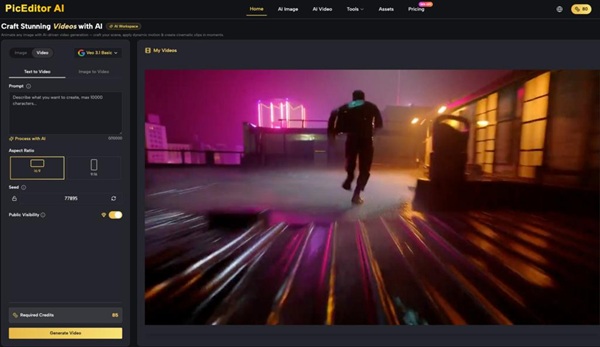
The mistake most teams make is viewing Image-to-Video (I2V) as a linear translation where the video prompt does the heavy lifting. In reality, the success of a motion asset is determined long before the first frame is rendered. The source image is not just a reference; it is a technical blueprint. If that blueprint is noisy, the motion model will interpret that noise as kinetic data, leading to the collapse of visual fidelity. Reliable commercial output requires shifting the focus back to the static stage, using a rigorous AI Photo Editor workflow to create a "clean" anchor that dictates the limits of generative motion.
The High Cost of Generative Drift in Ad Creative
Generative drift is the primary enemy of performance marketing. When a brand launches a campaign, visual consistency is the only way to maintain a recognizable identity across dozens of variations. However, most motion models, including high-end systems like Kling or Veo, are inherently probabilistic. They calculate what the next pixel should be based on a training set of millions of videos. If the source image contains ambiguity—such as a cluttered background, poorly defined edges, or low-resolution textures—the AI attempts to "resolve" these ambiguities by animating them.
This results in a phenomenon where a product’s silhouette might change as it moves, or a background element might suddenly merge into the foreground subject. For a performance marketer, this is more than an aesthetic annoyance; it is a conversion killer. High-entropy motion distracts the viewer and signals "AI-generated" in a way that feels cheap rather than innovative. To move from a luck-based workflow to a deterministic production chain, teams must treat the source image as the primary site of quality control. The goal is to provide the video model with a high-fidelity "latent anchor" that leaves no room for misinterpretation.
The Anchor Concept: Defining Boundaries with an AI Photo Editor
In a professional production pipeline, the source image must be sanitized. A raw photograph or a basic AI-generated image usually contains too much peripheral data. If you are trying to animate a bottle of perfume, a simple Photo Edit allows you to isolate that subject with surgical precision. By using features like object erasure and background removal, you effectively tell the motion model: "These pixels are the subject; these pixels are the environment."
When you use an AI Photo Editor to clean up the frame, you are essentially reducing the cognitive load on the motion algorithm. In-painting and sophisticated retouching tools within the PicEditor AI suite allow creators to remove distracting elements that might otherwise "melt" during the transition to video. For instance, if there is a stray shadow on a product, a motion model might interpret that shadow as a moving object or a liquid. By flattening the lighting and refining the edges in the static stage, the resulting video output becomes significantly more stable. The "latent anchor" provided by a high-resolution, pre-edited image ensures that the transition between frames remains grounded in the original geometry of the subject.
Mapping Static Attributes to Kinetic Variables
The relationship between image quality and motion reliability is not just about resolution; it is about data clarity. Contrast and edge definition in the source image directly impact how well a motion model calculates depth maps. When a model "sees" a sharp edge, it can accurately place that object in 3D space. When the edges are soft or pixelated, the depth map becomes muddy, leading to the "rubber-band" effect where objects appear to stretch and contract unnaturally.
This is where specific pre-processing steps become non-negotiable. Background removal is perhaps the most critical. By replacing a complex, noisy background with a clean, high-contrast environment using an AI Photo Editor, you prevent the "melting" effect often seen in complex I2V generations. Furthermore, aspect ratio alignment must happen at the image stage. Feeding a 4:3 image into a 16:9 video workflow often forces the AI to "hallucinate" the margins, which is where the highest degree of artifacting occurs. By pre-extending the canvas (out-painting) in a dedicated photo environment, you provide the video engine with the exact spatial data it needs to animate the full frame without guesswork.
Technical Constraints and the Hallucination Ceiling
It is important to maintain a level of skepticism regarding what even the best pre-processing can achieve. We are currently operating at a "hallucination ceiling." Even with a perfectly edited source image, current I2V technology struggles with fundamental physics logic. High-entropy scenarios—such as long hair blowing in a complex breeze or hands interacting with small, intricate objects—remain high-risk. No amount of static sharpening can force an AI to understand that a finger should not pass through a solid coffee cup if the motion model lacks a robust internal physics engine.
There is also the persistent hurdle of text legibility. While an AI Photo Editor can produce crisp, perfectly rendered text on a product label, the moment that image is animated, the text often becomes "soupy" or transforms into a pseudo-language. Marketers must accept that, for now, high-fidelity text is best added in post-production via traditional motion graphics rather than relying on the generative video model to maintain it. Acknowledging these limitations allows teams to focus their generative efforts on what the tools do well—lighting, atmosphere, and broad movement—rather than wasting cycles on physics-heavy tasks that the technology isn't ready to handle reliably.
Economic Efficiency: Reducing CAC Through Systematic Pre-Processing
The commercial argument for rigorous pre-editing is rooted in the economics of GPU time. In a high-volume ad environment, every minute spent "re-rolling" a video is a drain on the creative budget. Iterating on a static image is roughly 10 to 20 times cheaper in terms of computational credits and human time than generating, reviewing, and discarding a 10-second video clip.
By investing 15 minutes in a high-fidelity preparation phase using an AI Photo Editor, a creator can often reduce their video "trash rate" from 70% to under 20%. This efficiency allows for a much more aggressive testing cycle. Instead of hoping for one good video, you can reliably generate five variations of the same pre-vetted anchor image. Within the PicEditor AI ecosystem, building a "source library" of these pre-vetted, high-fidelity images becomes a strategic asset. You aren't just saving files; you are building a repository of stable seeds that can be repurposed across different motion styles, from slow-pan cinematic shots to high-energy social media cuts.
Moving Toward a Deterministic Creative Workflow
The transition from "AI as a toy" to "AI as a production tool" requires a shift in mindset. We must stop treating generative tools as magic boxes that turn prompts into finished products and start treating them as components in a modular system. In this system, the AI Photo Editor acts as the quality gatekeeper. It is the tool that ensures the brand’s visual DNA is preserved before the unpredictable variables of motion are introduced.
For the performance marketer, the goal isn't just to produce video; it's to produce video that converts without compromising the brand. By mastering the static source—through careful background management, resolution upscaling, and object isolation—you create a foundation that can withstand the pressures of generative motion. The future of AI video belongs to those who understand that the most important part of the video is the single, silent frame that comes before it. The reliability of the output is always a direct reflection of the precision of the input.